Free Download Viking Board Game Hnefatafl Rules Programs That Help
Stealth chess - opening positionStealth Chess is a, played in the, according to.It is similar to normal, with the exception of an extra piece and the widening of the board by two specially-colored fields (red and white are described, as opposed to the normal black and white) on either side, known as the Slurks. The extra piece is the (appearing on either side of the Rooks in the beginning of the game), the only piece to be able to move in the Slurk.The Assassin moves one square in any direction, and two to capture; however, on exiting the Slurks, the assassin may make as many moves as it has taken within the Slurks and, optionally, a capture move.An example may clarify: If an Assassin enters the Slurks and takes five moves within them (in any direction, including back and forth), it may then appear in any square that is five moves from its original entry point into the Slurk. It is then still able to make a one-square move to capture.
If an Assassin were to make fifteen moves (the minimum necessary to go from one corner of the normal board to the opposite corner), it could reappear anywhere on the board. The mechanism of moving the assassin up and down the Slurks is used in order to a) use up a move by the player and b) to keep count of how many spaces the assassin has moved.The Slurks are, in essence, a second, 'invisible' board, through which only the Assassin may travel, and from which it may reemerge on the 'visible' board at any time. The Assassin may take pieces of its own colour, should this give the player an advantage, but may not take opposing Assassins (professional courtesy). Many players consider the assassin to be moving 'underneath' the actual board, ready to pop out when they have reached their intended destination.This makes it a highly powerful piece and a very effective counter to certain strategies depending on specific pieces, and can quickly win the game if one manages to take control of the Slurks and access the King directly. A Thud game's initial positions. 'd' represents the dwarfs, 'T' represents the trolls, and 'X' represents the Thudstone.The playing area consists of a 15 by 15 square board from which a triangle of 5 squares in each corner has been removed. The Thudstone is placed on the centre square of the board, where it remains for the entire game and may not be moved onto or through.
The eight trolls are placed onto the eight squares adjacent to the Thudstone and the thirty-two dwarfs are placed so as to occupy all the perimeter spaces except for the four in the same horizontal or vertical line as the Thudstone. One player takes control of the dwarfs, the other controls the trolls. The dwarfs move first.On the dwarfs' turn, they may either move or hurl one dwarf:. Move: any one dwarf is moved like a, any number of squares in any orthogonal or diagonal direction, but not onto or through any other piece, whether Thudstone, dwarf, or troll; or.
Hurl: anywhere there is a straight (orthogonal or diagonal) line of adjacent dwarfs on the board, they may hurl the front dwarf in the direction continuing the line, as long as the space between the lead dwarf and the troll is less than the number of dwarfs in the line. This is different from a normal move in that the dwarf is permitted to land on a square containing a troll, in which case the troll is removed from the board and the dwarf takes his place. This may only be done if the endmost dwarf can land on a troll by moving in the direction of the line at most as many spaces as there are dwarfs in the line. Since a single dwarf is a line of one in any direction, a dwarf may always move one space to capture a troll on an immediately adjacent square.On the trolls' turn, they may either move or shove one troll:. Move: one troll is moved like a, one square in any orthogonal or diagonal direction onto an empty square.
After the troll has been moved, any dwarfs on the eight squares adjacent to the moved troll may optionally be immediately captured and removed from the board, at the troll player's discretion; or. Shove: anywhere there is a straight (orthogonal or diagonal) line of adjacent trolls on the board, they may shove the endmost troll in the direction continuing the line, up to as many spaces as there are trolls in the line. As in a normal move, the troll may not land on an occupied square, and any dwarfs in the eight squares adjacent to its final position may immediately be captured. Trolls may only make a shove if by doing so they capture at least one dwarf.The battle is over when both players agree that no more captures can be made by continuing to play, or when one player has no more valid moves to make. At this point the players count score: the dwarfs score 1 point for each surviving dwarf, and the trolls score 4 for each remaining troll, with the difference being the 'final' score. The players should then swap sides to play another round, and the sum of their final scores for the two battles determines the overall victor.Tactics The basic overall strategy for the dwarfs to form a large group and for the trolls to try to stop them.A dwarf's strategy does widely depend on how the trolls are advancing on the dwarf block.
A good tactic therefore is to be prepared to sacrifice a few dwarfs to get in the way and slow down any trolls that are advancing into dangerous positions. The board and initial positions for Thud: The Koom Valley. D for Dwarves, T for Trolls, X for Thudstone, dark gray - far side of the valley.
The Game Board
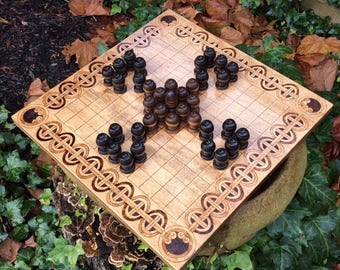

Hnefatafl Online
Koom Valley Thud For the 2005 rerelease of Thud, Truran devised a substantially different game that could be played with the same board and pieces, known as Koom Valley Thud. Unlike the original release, in which the publishers attempted to keep the game rules secret so that anyone wishing to play would have to buy the official set, the rules for Koom Valley Thud were posted on the so that owners of the original edition would have access to the new rules.Setup There are only sixteen dwarfs in Koom Valley Thud. Fifteen are placed so as to fill two diagonal sides of the board and the orthogonal side between them. The sixteenth is placed next to the Thudstone, called the Rock in this variant, on the dwarfs' side. The eight trolls are arranged in a symmetrical pattern in three groups on the other side.Objective For the dwarfs to win, they must move the rock to the far side of the valley – onto any of the five squares on the opposite side of the board against which the dwarf player is sitting.
For the trolls to win, they must capture the rock by placing three trolls adjacent to it (in any direction including diagonally). If neither side can achieve their objective, the game is drawn.Movement Movement is the same as Classic Thud except that trolls may now move up to 3 spaces in any direction (horizontal, vertical or diagonal).Dwarfs may move the Rock instead of moving a dwarf piece. It may move only one square in any direction. To be moved it must be next to a dwarf and it must also be next to a dwarf at the end of its move.Captures A troll captures a dwarf by trampling over it. It moves in a straight line from a square next to the dwarf, through the square the dwarf is on and lands on the empty square immediately beyond. The trampled dwarf is removed from the board.Several captures may be made in one move and a change of direction is allowed between captures.Dwarfs capture a troll by moving a dwarf so that the troll is trapped between two dwarfs in any straight line (including diagonally).
The three pieces, two dwarfs and a troll, must all be in line.If the dwarf that has been moved also traps another troll between itself and another dwarf, that troll is also captured.Captures are only made when the capturing side moves a piece. The rock may be moved and come to rest next to three trolls. It can only be captured when a troll is moved.See also.External links.
An eight suit pack of cards suitable for playing Cripple Mr Onion. A play-against-your-computer version is available at (Note from program author: 1.
The program is embarrassingly poor, and 2. I've lost the source, so don't ask!)Wikimedia Commons has media related to., including Pratchett's Story of Thud. at BoardGameGeek. This illustrates both what the official game set looks like, and the initial positions. at.

by Marc Boeren is software for playing Thud. Zillions of Games implementation.References.