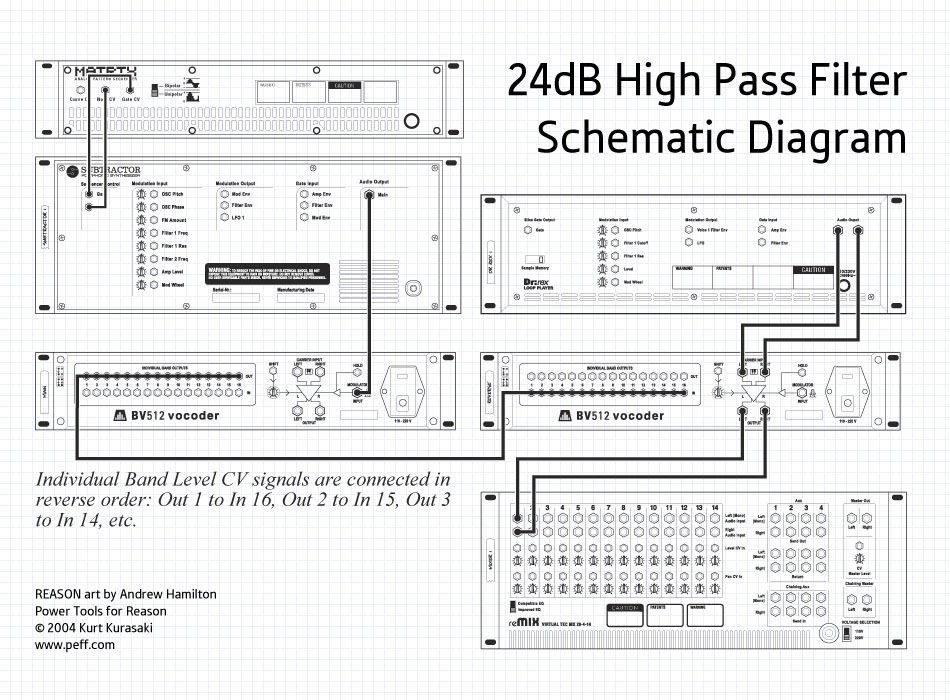
Bv 512 Digital Vocoder Schematic
Early 1970s vocoder, custom built for electronic music bandA vocoder (, a of voice and encoder) is a of that the human voice signal for, or voice transformation.The earliest type of vocoder, the channel vocoder, was originally developed as a voice codec for applications in the 1930s for speech to conserve in transmission.By the control signals, voice transmission can be secured against interception. Its primary use in this fashion is for secure radio communication. The advantage of this method of encryption is that none of the original signal is sent, only envelopes of the bandpass filters. The receiving unit needs to be set up in the same filter configuration to re-synthesize a version of the original signal spectrum.The vocoder has also been used extensively as an. The decoder portion of the vocoder, called a, can be used independently for. This section does not any.
Reason 10 Vocoder
Unsourced material may be challenged. ( July 2019) The consists of sounds generated by the opening and closing of the by the, which produces a periodic waveform with many. This basic sound is then by the nose and throat (a complicated piping system) to produce differences in harmonic content in a controlled way, creating the wide variety of sounds used in speech. There is another set of sounds, known as the and sounds, which are created or modified by the mouth in different fashions.The vocoder examines speech by measuring how its spectral characteristics change over time. This results in a series of signals representing these modified frequencies at any particular time as the user speaks. In simple terms, the signal is split into a number of frequency bands (the larger this number, the more accurate the analysis) and the level of signal present at each frequency band gives the instantaneous representation of the spectral energy content.
To recreate speech, the vocoder simply reverses the process, processing a broadband noise source by passing it through a stage that filters the frequency content based on the originally recorded series of numbers.Specifically, in the encoder, the input is passed through a multiband, then each band is passed through an, and the control signals from the envelope followers are transmitted to the decoder. The decoder applies these (amplitude) control signals to corresponding amplifiers of the filter channels for.Information about the instantaneous frequency of the original voice signal (as distinct from its spectral characteristic) is discarded; it was not important to preserve this for the purposes of the vocoder's original use as an encryption aid. It is this 'dehumanizing' aspect of the vocoding process that has made it useful in creating special voice effects in popular music and audio entertainment.The vocoder process sends only the parameters of the vocal model over the communication link, instead of a point-by-point recreation of the waveform.
Since the parameters change slowly compared to the original speech waveform, the bandwidth required to transmit speech can be reduced. This allows more speech channels to utilize a given, such as a radio channel or a.Analog vocoders typically analyze an incoming signal by splitting the signal into a number of tuned frequency bands or ranges.
A and are sent through a series of these tuned. In the example of a typical robot voice, the modulator is a and the carrier is noise or a. There are usually between eight and 20 bands.The amplitude of the modulator for each of the individual analysis bands generates a voltage that is used to control amplifiers for each of the corresponding carrier bands. The result is that frequency components of the modulating signal are mapped onto the carrier signal as discrete amplitude changes in each of the frequency bands. (See ).Often there is an unvoiced band or channel.
This is for frequencies that are outside the analysis bands for typical speech but are still important in speech. Examples are words that start with the letters s, f, ch or any other sibilant sound. These can be mixed with the carrier output to increase clarity. The result is recognizable speech, although somewhat 'mechanical' sounding.
Vocoders often include a second system for generating unvoiced sounds, using a instead of the.In the channel vocoder algorithm, among the two components of an, considering only the component and simply ignoring the component tends to result in an unclear voice; on methods for rectifying this, see.History. HY-2 Vocoder (designed in 1961), was the last generation of channel vocoder in the.The development of a vocoder was started in 1928 by engineer, who was granted patents for it, on March 21, 1939, and on Nov 16, 1937.Then, to show the ability of its part, (Voice Operating Demonstrator, ), was introduced to the public at the AT&T building at the 1939–1940 New York World's Fair. The Voder consisted of a switchable pair of and as a sound source of tone and, 10-band with as a, and the manual controllers including a set of pressure-sensitive keys for filter control, and a for of tone. The filters controlled by keys convert the tone and the hiss into,.
This was a complex machine to operate, but a skilled operator could produce recognizable speech.Dudley's vocoder was used in the system, which was built by engineers in 1943. SIGSALY was used for encrypted high-level voice communications during. The KO-6 voice coder was released in 1949 in limited quantities; it was a close approximation to the SIGSALY at 1200 bps.
In 1953, KY-9 THESEUS 1650 bps voice coder used solid state logic to reduce the weight to 565 pounds (256 kg) from SIGSALY's 55 tons, and in 1961 the HY-2 voice coder, a 16-channel 2400 bps system, weighted 100 pounds (45 kg) and was the last implementation of a channel vocoder in a secure speech system.Later work in this field has since used digital. The most widely used speech coding technique is (LPC), which was first proposed by of and Shuzo Saito of (NTT) in 1966. Another speech coding technique, (ADPCM), was developed by P. Cummiskey, and at in 1973. Applications. Terminal equipment for based systems. Digital Trunking.
DMR TDMA. Digital Voice Scrambling and Encryption. Voice Storage and Playback Systems. Messaging Systems.
Voice Pagers. Regenerative Digital Voice Repeaters. Cochlear Implants. Musical and other artistic effectsModern implementations.
Main articles: andEven with the need to record several frequencies, and additional unvoiced sounds, the compression of vocoder systems is impressive. Standard speech-recording systems capture frequencies from about 500 Hz to 3,400 Hz, where most of the frequencies used in speech lie, typically using a sampling rate of 8 kHz (slightly greater than the ). The sampling resolution is typically 12 or more bits per sample resolution (16 is standard), for a final data rate in the range of 96–128 kbit/s, but a good vocoder can provide a reasonably good simulation of voice with as little as 2.4 kbit/s of data.' Toll quality' voice coders, such as ITU G.729, are used in many telephone networks.
G.729 in particular has a final data rate of 8 kbit/s with superb voice quality. G.723 achieves slightly worse quality at data rates of 5.3 kbit/s and 6.4 kbit/s. Many voice vocoder systems use lower data rates, but below 5 kbit/s voice quality begins to drop rapidly.Several vocoder systems are used in:. LPC-10, Pub 137, 2400 bit/s, which uses. (CELP), 2400 and 4800 bit/s, Federal Standard 1016, used in. (CVSD), 16 kbit/s, used in wide band encryptors such as the. (MELP), MIL STD 3005, 2400 bit/s, used in the Future Narrowband Digital Terminal, 's 21st century secure telephone.
, former G.721, 32 kbit/s used in secure telephone(ADPCM is not a proper vocoder but rather a waveform codec. Main article:Since the late 1970s, most non-musical vocoders have been implemented using, whereby the target signal's spectral envelope (formant) is estimated by an all-pole. In linear prediction coding, the all-pole filter replaces the bandpass filter bank of its predecessor and is used at the encoder to whiten the signal (i.e., flatten the spectrum) and again at the decoder to re-apply the spectral shape of the target speech signal.One advantage of this type of filtering is that the location of the linear predictor's spectral peaks is entirely determined by the target signal, and can be as precise as allowed by the time period to be filtered.
This is in contrast with vocoders realized using fixed-width filter banks, where spectral peaks can generally only be determined to be within the scope of a given frequency band. LP filtering also has disadvantages in that signals with a large number of constituent frequencies may exceed the number of frequencies that can be represented by the linear prediction filter. This restriction is the primary reason that LP coding is almost always used in tandem with other methods in high-compression voice coders.Waveform-interpolative Waveform-interpolative (WI) vocoder was developed in AT&T around 1995 by W.B. Kleijn, and subsequently a low- complexity version was developed by AT&T for the DoD secure vocoder competition. Notable enhancements to the WI coder were made at the. AT&T holds the core patents related to WI, and other institutes hold additional patents. Using these patents as a part of WI coder implementation requires licensing from all IPR holders.
Artistic effects. Siemens Synthesizer (c.1959) at Studio for Electronic Music was one of the first attempts to use a vocoder to create musicOne of the first attempts to use a vocoder in creating music was the 'Siemens Synthesizer' at the Siemens Studio for Electronic Music, developed between 1956 and 1959.In 1968, developed one of the first musical vocoders for the electronic music studio of the.In 1968, built a prototype vocoder, named 'Farad' after.
It was first featured on 'The Electronic Record For Children' released in 1969 and then on his rock album released in 1970.In 1970, and built another musical vocoder, a ten-band device inspired by the vocoder designs of. It was originally called a spectrum encoder-decoder, and later referred to simply as a vocoder. The carrier signal came from a Moog, and the modulator from a input. The output of the ten-band vocoder was fairly intelligible, but relied on specially articulated.
Later improved vocoders use a high-pass filter to let some through from the microphone; this ruins the device for its original speech-coding application, but it makes the 'talking synthesizer' effect much more intelligible.used a vocoder to provide a vocal effect for his 1981 international hit single '.Vocoders have appeared on pop recordings from time to time, most often simply as a rather than a featured aspect of the work. However, many experimental electronic artists of the genre often utilize vocoder in a more comprehensive manner in specific works, such as (on, 1984) and (on, 1980 and, 1982).Vocoder module and use by M.
Oldfield can be clearly seen on his 'Live At Montreux 1981' DVD (Track 'Sheba').There are also some artists who have made vocoders an essential part of their music, overall or during an extended phase. Examples include the German group, ('Send One Your Love', 'A Seed's a Star') and jazz/fusion keyboardist during his late 1970s period.
Tal Vocoder Tutorial
In 1982 used a Sennheiser Vocoder VSM201 on six of the nine tracks on. Perhaps the most heard, yet often unrecognized, example of the use of a vocoder in popular music, is on 's 1982 album, in the song '. During the first few seconds of the song, the background voicings 'ooh-ooh, ooh, ooh', behind his spoken words, exemplify the heavily modulated sound of his voice through a Vocoder. The bridge features a vocoder as well ('Pretty young thing/You make me sing'), courtesy of session musician.have used a vocoder in some of their songs. For example, in ' and ', both from the album (2011), 's vocals are mostly vocoder-processed. ', from (2014), also features Martin singing through a vocoder. The hidden track 'X Marks The Spot' from ' has also been recorded through a vocoder.Noisecore band have used vocoders in variety of their songs and live performances such as (2002) alongside other digital audio technology both old and new.Red Hot Chili Peppers song By the Way uses a vocoder effect on Anthony Kiedis' vocals.Among the most consistent uses of vocoder in emulating the human voice are, who have used this instrument from their first album (1997) to their latest work (2013) and consider the convergence of technological and human voice 'the identity of their musical project'.
For instance, the lyrics of ' (1997) are integrally vocoder-processed, ' (2013) features a mix of natural and processed human voices, and ' (2013) features singing into a vocoder.Voice effects in other arts. Demonstration of the 'robotic voice' effect found in film and television.Problems playing this file? See.Vocoders are used in, and games, usually for robots or talking computers.The robot voices of the in were created with an EMS Vocoder 2000. The of the theme, as arranged and recorded by, has a section of the main melody generated by a Roland SVC-350 Vocoder. A vocoder was also used to create the iconic voice of, a character from the series.In 1967 the series It was used in the closing credits theme of the first 14 episodes to provide the repetition of the words 'Captain Scarlet'.In 1972, 's first album Electric Samurai: Switched on Rock was an early attempt at applying technique through a vocoder in. The album featured electronic renditions of contemporary and songs, while utilizing synthesized voices in place of human voices.
In 1974, he utilized synthesized voices in his popular album, which became a worldwide success and helped to popularize electronic music. Used it for the album (1973). See also.for musical applications.References. (Motion picture). 1939.A demonstration of the (not the Vocoder). (Video).Details of the Siemens Electronic Music Studio, exhibited at the. Bruce Haack (1970).
Columbia Records.A sample of earlier Vocoder. T-Pain (2005). (CD Single/Download). Jive Records.A sample of effect (a.k.a.
AT&T Bell Labs. 1961.A sample of earlier computer based and song synthesis, by and at, using computer.
The demo song “”, musical accompanied by, impressed and later he used it in the climactic scene of the screenplay for his novel. (Video). Texas Instruments. 1980.A sample of.External links Wikimedia Commons has media related to.